Micro Conversions: The Small Wins That Lead to Big Results

Most businesses obsess over one number: the final conversion. The purchase. The signup. The subscription. However, focusing only on that end goal is like judging a marathon runner solely by whether they crossed the finish line—ignoring the thousands of steps that got them there. Micro conversions are those smaller steps, and understanding them can transform how you optimize your website.
In my experience working with e-commerce and SaaS clients, tracking micro conversions has consistently revealed optimization opportunities that macro conversion data alone would never show. These small wins compound into significant results over time.
What Are Micro Conversions?
A micro conversion is any small action a visitor takes that indicates progress toward your primary goal. Think of them as stepping stones on the path to your main conversion. While a macro conversion might be completing a purchase, micro conversions include actions like adding an item to cart, viewing product details, or signing up for a newsletter.
The distinction matters because micro conversions help you understand where in the journey visitors engage or drop off. Without this granular view, you’re essentially flying blind between someone landing on your site and either converting or leaving.
Examples of Micro Conversions
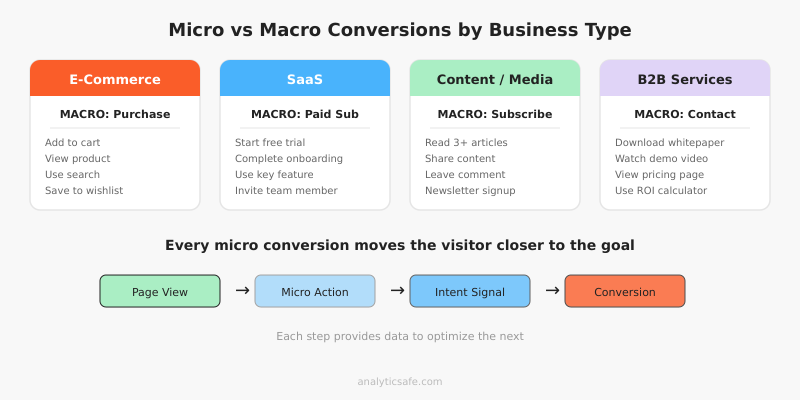
Micro conversions vary depending on your business model. Here are common examples across different industries:
| Business Type | Macro Conversion | Micro Conversions |
|---|---|---|
| E-commerce | Purchase | Add to cart, view product, use search, apply filter, save to wishlist |
| SaaS | Paid subscription | Start free trial, complete onboarding, use key feature, invite team member |
| Content/Media | Subscription | Read 3+ articles, share content, comment, newsletter signup |
| B2B Services | Contact request | Download whitepaper, watch demo video, view pricing page, use calculator |
Why Micro Conversions Matter for Optimization
Tracking only macro conversions creates a significant blind spot. For instance, if your e-commerce conversion rate drops from 2.5% to 2.0%, you know something’s wrong—but you don’t know what. Are fewer people adding items to cart? Is the checkout process failing? Are visitors not finding products?
Micro conversions answer these questions. They break down the customer journey into measurable segments, allowing you to identify exactly where problems occur. Consequently, your optimization efforts become targeted rather than guesswork.
The Funnel Visibility Problem
I’ve seen this scenario many times: a client notices declining conversions and immediately wants to redesign their checkout page. After setting up proper micro conversion tracking, we discovered the real issue was much earlier—visitors weren’t using the search function effectively, so they never found products to buy in the first place.
Without micro conversion data, they would have wasted resources optimizing the wrong part of their site. This happens more often than you’d think. Therefore, establishing micro conversion tracking should precede any major optimization project.
How to Identify Your Key Micro Conversions
Not every small action deserves tracking. The goal is identifying actions that genuinely indicate progress toward conversion. Here’s a framework I use with clients:
Step 1: Map Your Customer Journey
Start by listing every step a typical visitor takes from arrival to conversion. For an e-commerce site, this might look like:
- Land on homepage or category page
- Browse or search for products
- View individual product pages
- Add item to cart
- Begin checkout
- Complete purchase
Each transition between steps represents a potential micro conversion worth tracking.
Step 2: Identify Intent Signals
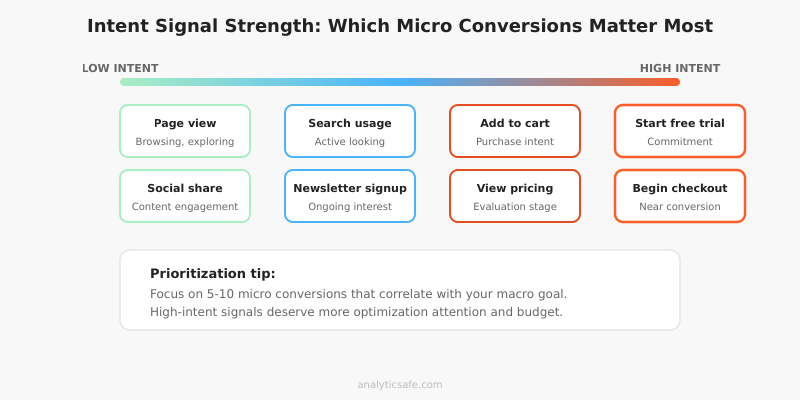
Some actions signal stronger purchase intent than others. Adding an item to cart shows more commitment than simply viewing a product. Similarly, viewing your pricing page indicates more serious interest than reading a blog post.
Prioritize tracking actions that correlate strongly with eventual conversion. In my experience, these high-intent micro conversions include:
- Adding products to cart or wishlist
- Starting a free trial or demo
- Viewing pricing information
- Using product comparison tools
- Returning to site within 7 days
Step 3: Consider Privacy Implications
When setting up micro conversion tracking, remember that more tracking isn’t always better. Each tracked action should serve a clear optimization purpose. Additionally, ensure your tracking respects user privacy and complies with regulations like GDPR.
Privacy-focused analytics tools like Plausible and Fathom can track custom events (micro conversions) without invasive user tracking. This approach aligns with the privacy-first analytics philosophy that respects both business needs and user trust.
Setting Up Micro Conversion Tracking
The technical implementation varies by platform, but the principles remain consistent. You need to define what counts as a conversion, capture when it occurs, and aggregate the data meaningfully.
Defining Conversion Events
Be specific about what triggers each micro conversion. “Viewed product” is vague—does scrolling past a product card count? A better definition: “Clicked through to individual product detail page and remained for at least 5 seconds.”
Specificity prevents inflated numbers that don’t reflect genuine engagement. Here’s how I typically define common e-commerce micro conversions:
| Micro Conversion | Trigger Definition |
|---|---|
| Product view | Product detail page loaded, 5+ seconds on page |
| Add to cart | Item added to cart (button click confirmed) |
| Begin checkout | Checkout page loaded with items in cart |
| Search usage | Search query submitted with 1+ results |
| Filter usage | Category or attribute filter applied |
Measuring Conversion Rates Between Steps
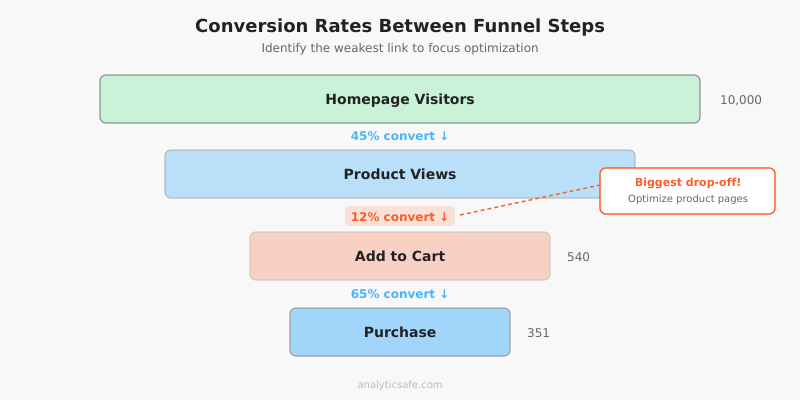
Once tracking is active, calculate conversion rates between each step. This reveals your funnel’s weak points. For example:
- Homepage → Product view: 45%
- Product view → Add to cart: 12%
- Add to cart → Begin checkout: 65%
- Begin checkout → Purchase: 70%
In this example, the product view to add-to-cart step has the lowest conversion rate. That’s where optimization efforts should focus first. Perhaps product pages lack compelling information, or the add-to-cart button isn’t prominent enough.
Using Micro Conversion Data for Optimization
Data without action is just numbers. Here’s how to translate micro conversion insights into actual improvements.
Identify Drop-Off Points
Look for steps where conversion rates are significantly lower than industry benchmarks or your historical averages. These drop-off points indicate friction in the user experience.
When I work with clients on A/B testing, we prioritize tests based on micro conversion data. A page with 80% drop-off deserves attention before a page with 20% drop-off—the potential impact is simply greater.
Segment by Traffic Source
Different traffic sources often show different micro conversion patterns. Visitors from organic search might browse more products before purchasing, while email subscribers might go straight to checkout. Understanding these patterns through proper attribution modeling helps you optimize for each audience segment.
For instance, if social media traffic has high product view rates but low add-to-cart rates, perhaps those visitors need more social proof or reviews on product pages. Meanwhile, search traffic might need better navigation to find relevant products quickly.
Set Realistic Improvement Targets
Micro conversion data enables specific, measurable goals. Instead of “improve conversions,” you can target “increase add-to-cart rate from 12% to 15%.” This specificity makes success measurable and keeps teams focused.
In my experience, improving a single micro conversion rate by even 2-3 percentage points can significantly impact overall revenue. The compound effect of multiple small improvements often exceeds what a single major change could achieve.
Common Micro Conversion Mistakes to Avoid
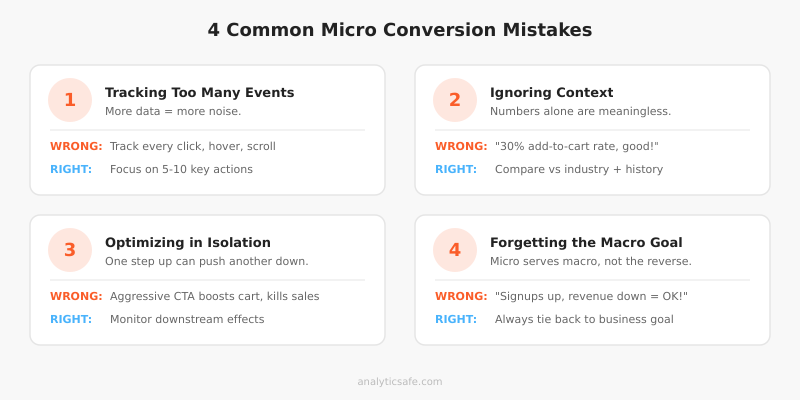
After helping dozens of businesses implement micro conversion tracking, I’ve noticed several recurring mistakes.
Tracking Too Many Events
More data isn’t always better. Tracking every possible interaction creates noise that obscures meaningful signals. Focus on 5-10 key micro conversions that directly relate to your business goals. You can always add more later if needed.
Ignoring Context
A micro conversion rate of 30% means nothing without context. Is that good or bad? Compare against your historical data, industry benchmarks, and different segments. A 30% add-to-cart rate might be excellent for luxury goods but concerning for low-cost impulse purchases.
Optimizing Micro Conversions in Isolation
Improving one micro conversion can sometimes hurt others. For example, making the add-to-cart button more aggressive might increase add-to-cart rates but decrease eventual purchases if customers feel pressured. Always monitor downstream effects of changes.
Forgetting the Macro Goal
Micro conversions serve the macro conversion, not the other way around. I’ve seen teams celebrate improved newsletter signups while overall revenue declined. The newsletter signups only matter if they eventually contribute to the primary business goal.
Micro Conversions and Privacy-First Analytics
You might wonder whether micro conversion tracking conflicts with privacy-focused analytics. It doesn’t have to. The key distinction is tracking actions rather than individuals.
Privacy-respecting analytics tools can tell you that 500 people added items to cart yesterday without identifying those individuals or following them across the web. This aggregate data is sufficient for optimization purposes and respects user privacy.
When I set up micro conversion tracking for clients using tools like Matomo (self-hosted) or Plausible, we configure events to capture action data without personal identifiers. You get the optimization insights without the privacy concerns—a genuine win-win situation.
Bottom Line
Micro conversions bridge the gap between traffic and revenue. They reveal where visitors engage, where they hesitate, and where they leave. Without this visibility, optimization becomes guesswork.
Start by identifying 5-7 key micro conversions that indicate genuine progress toward your main goal. Set up tracking that captures these events without compromising user privacy. Then use the data to focus optimization efforts where they’ll have the greatest impact.
The businesses I’ve seen succeed with conversion optimization share one trait: they understand the journey, not just the destination. Micro conversions give you that understanding. Use them wisely, and those small wins will compound into results that matter.