Referral Traffic: How to Read, Grow, and Clean It Up
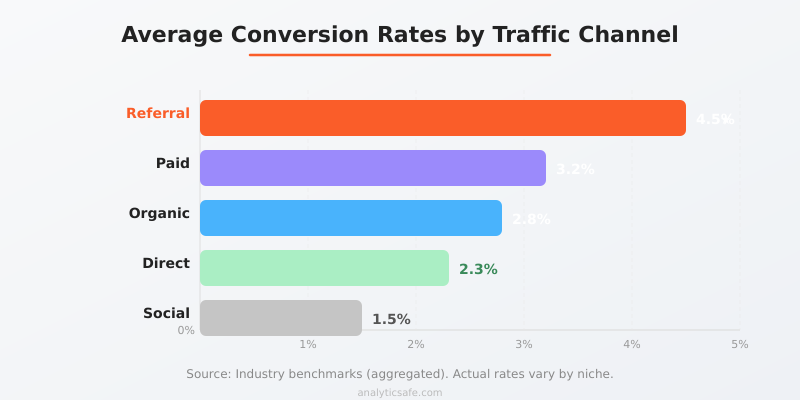
When someone clicks a link on another website and lands on yours, that’s referral traffic. It’s one of the most underrated traffic sources because it carries built-in trust. A visitor who arrives from a recommendation — whether it’s a blog post, a forum thread, or a partner site — already has context about why they’re visiting. Consequently, referral traffic often converts better than organic search or paid ads.
However, not all referral traffic is created equal. In my experience, most businesses have a mix of valuable referrals and spam that clutters their analytics. Understanding how to read, grow, and clean up this traffic source gives you a clearer picture of what’s actually driving results. Moreover, it helps you double down on the sources that matter.
What Is Referral Traffic?
Referral traffic is any visit to your website that comes from a direct link on another site, rather than from a search engine, social media, or typed-in URL. When a blog links to your product page, when a news site mentions your company, or when a partner features you in their resource list — those clicks all count as referral traffic.
Technically, referral traffic is identified through the HTTP referrer header. When a user clicks a link, the browser sends information about the originating page to the destination. Your analytics tool then categorizes that visit as a referral and records the source domain.
It’s worth distinguishing referral traffic from other channel types:
| Channel | How Users Arrive | Example |
|---|---|---|
| Referral | Clicking a link on another website | Blog post links to your site |
| Organic Search | Clicking a search engine result | Google search result |
| Direct | Typing URL or using bookmark | User types example.com |
| Social | Clicking link on social platform | Facebook, LinkedIn, Twitter |
| Paid | Clicking a paid advertisement | Search or display ads |
Some analytics tools categorize social media traffic separately. Others include it under referrals. In my practice, however, I keep them separate because the intent behind social clicks differs significantly from editorial referrals.
Why Referral Traffic Matters
This channel deserves attention for several practical reasons that directly affect your bottom line.
Higher trust and conversion rates
Users who arrive via referral typically trust you more from the start. Someone who clicks a link in a respected industry blog expects quality on the other end. As a result, referral visitors often have lower bounce rates and higher conversion rates compared to other channels. In my work with SaaS clients, for instance, referral visitors convert at 2-3x the rate of generic organic traffic.
SEO signals
Legitimate referral links are also backlinks. And backlinks remain one of the strongest ranking factors for search engines. Therefore, growing your referral sources often improves your organic search visibility simultaneously. The two channels reinforce each other. Every genuine editorial link that sends referral traffic also tells search engines your content is valuable. According to research from Moz, backlinks from high-authority domains have a measurable impact on search rankings.
Diversified traffic sources
Relying too heavily on one traffic source is risky. Algorithm changes, ad cost increases, or platform policy shifts can cut your traffic overnight. Referral sources provide a buffer. Furthermore, referral sources tend to be more stable over time because they’re based on genuine relationships and content quality rather than algorithmic favoritism.
Audience discovery
Additionally, referral data shows you which communities and publications care about your topic. This insight shapes your outreach strategy, content calendar, and partnership decisions. When I analyze referral reports for clients, I often discover niche forums or industry directories they never considered. These become reliable, ongoing traffic sources.
How to Read Your Referral Traffic Report
Most analytics tools provide a referral report that lists the domains sending you traffic. However, reading this report effectively requires looking beyond the surface numbers.
Key metrics to examine
For each referral source, track these metrics:
| Metric | What It Reveals | What to Look For |
|---|---|---|
| Sessions | Volume of traffic from this source | Consistent vs. one-time spike |
| Bounce rate | Quality and relevance of traffic | Under 60% for most sites |
| Pages per session | Engagement depth | Above 2 suggests genuine interest |
| Conversion rate | Business value of the source | Compare against site average |
| Average session duration | Content consumption | Longer is generally better |
A referral source sending 1,000 visits with a 95% bounce rate is worth less than one sending 50 visits with a 20% bounce rate and 8% conversion rate. Consequently, always evaluate referral quality alongside quantity.
Spotting patterns
Look for these patterns in your referral data:
- Consistent performers: Sources that send steady traffic month after month. These are your most valuable referrers. Nurture these relationships.
- Spike sources: A burst of traffic from a single mention. These are great but temporary. For instance, getting featured in a popular newsletter might send 5,000 visitors in a day but zero the next week.
- High-converting outliers: Small-volume sources with exceptional conversion rates. These audiences are highly aligned with your product. Therefore, they deserve targeted attention.
Understanding these patterns connects directly to multi-channel attribution. Referral traffic often plays an assisting role in conversion paths, introducing users who later return through search or direct visits.
How to Grow Referral Traffic
Growing this channel requires creating content worth linking to and building relationships with people who can share it. Here are the strategies that consistently work in my experience.
Create linkable assets
The foundation of referral traffic is content that other sites want to reference. Specifically, these formats attract the most links:
- Original research and data: Surveys, benchmarks, and industry statistics that people cite in their own content
- Comprehensive guides: Authoritative resources that become go-to references for a topic
- Tools and calculators: Interactive resources that provide unique value
- Infographics and visual data: Easy-to-embed visuals that earn attribution links
In my experience, original data consistently earns the most referral links. When I helped a SaaS client publish an annual industry benchmark report, it generated referral traffic from over 40 domains within three months. Nothing else we tried came close.
Guest contributions and expert quotes
Writing guest posts for relevant publications remains one of the most effective referral strategies. However, quality matters enormously. One well-placed article on a respected industry site delivers more value than ten posts on low-authority blogs.
Additionally, responding to journalist requests on platforms like HARO (Help a Reporter Out) can earn referral links from major publications. Moreover, getting quoted as an expert in industry articles builds both referral traffic and authority over time.
Resource page outreach
Many websites maintain curated resource pages listing the best tools, guides, or services in their niche. Getting listed on these pages creates a reliable, long-term referral source. Furthermore, resource pages often appear high in search results, multiplying the exposure.
To find relevant resource pages, search for queries like “[your topic] resources,” “[your industry] tools list,” or “best [your category] guides.” Then reach out to the site owners with a brief, personalized pitch explaining why your content deserves inclusion.
Strategic partnerships
Partnerships with complementary (not competing) businesses can drive consistent referral traffic. This includes co-authored content, joint webinars, cross-promotions, and integration directories. The key is finding partners whose audience overlaps with yours.
Cleaning Up Spam Referral Traffic
Spam referrals are one of the most annoying problems in analytics. It pollutes your data, inflates your traffic numbers, and makes genuine trends harder to spot. In some cases, spam referrals account for 10-30% of a site’s total inbound visits.
Types of referral spam
There are two main types of referral spam, and they work differently:
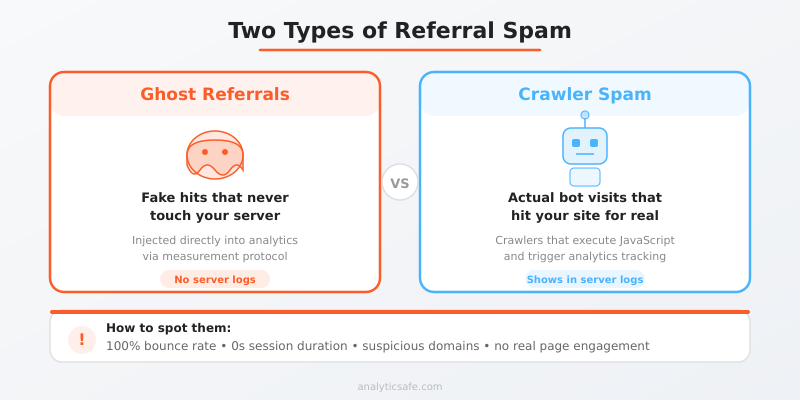
Ghost referrals never actually visit your site. They send fake hits directly to your analytics account by guessing or scraping your tracking ID. These appear in your reports as referral visits but never load your pages. Consequently, they typically show a 100% bounce rate and zero seconds on site.
Crawler spam involves bots that actually visit your website, setting the referrer header to their spam domain. These are harder to distinguish from real traffic because they do generate legitimate page requests.
How to identify spam referrals
Look for these telltale signs in your referral report:
- 100% bounce rate with 1 page per session
- Zero-second average session duration
- Domains you’ve never heard of with suspicious names
- Landing pages that don’t match your site structure (often showing “/” only)
- Sudden spikes from unknown sources
Before deleting anything, verify by visiting the suspicious domain in a safe browser. If it redirects to an unrelated product page, casino, or SEO service, it’s almost certainly spam. However, be cautious — some legitimate referrers have unusual domain names.
Filtering out spam
Privacy-respecting analytics tools like Matomo and Plausible handle referral spam differently. Matomo allows you to configure referrer spam lists and filter out known bot traffic at the server level. Plausible, by design, excludes most bot traffic automatically since it doesn’t use cookies or collect personal data.
For server-side filtering, you can block known spam domains in your web server configuration. This approach prevents spam bots from loading your pages at all. Additionally, maintaining a blocklist of known spam referrer domains and updating it periodically keeps your data clean.
Understanding the difference between real and spam traffic ties into broader measurement accuracy. As I discuss in my guide to privacy-focused analytics, choosing the right analytics tool significantly impacts data quality from the start.
Analyzing Referral Traffic Quality
Not all referral visits carry equal value. Therefore, you need a framework for evaluating which sources deserve investment and which are distractions.
The referral quality matrix
I categorize referral sources along two axes: volume and conversion quality. This creates four segments:
| High Conversion | Low Conversion | |
|---|---|---|
| High Volume | Stars — maximize and protect | Awareness — optimize landing pages |
| Low Volume | Hidden gems — invest to grow | Noise — deprioritize |
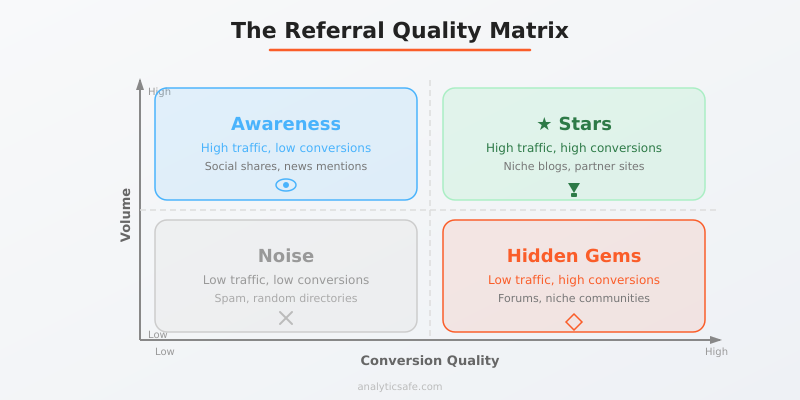
Stars are your best referral sources. Do everything you can to maintain and strengthen these relationships. Hidden gems are low-volume but high-converting — these audiences match your ideal customer profile perfectly. Invest in growing traffic from these sources because even small increases deliver outsized returns.
Awareness sources send lots of visitors who don’t convert immediately. Before writing them off, check whether they contribute to conversion paths as a micro conversion touchpoint. Often, referral visitors from awareness sources return later through direct or search channels to convert.
Common Referral Traffic Mistakes
After working with dozens of analytics implementations, I see these referral-related mistakes repeatedly.
Ignoring self-referrals
Self-referrals happen when your own domain appears as a referral source. This typically indicates tracking configuration problems, such as missing tracking codes on certain pages, cross-domain tracking issues, or payment gateway redirects. Self-referrals inflate your traffic numbers and distort your source attribution. Therefore, fixing them should be a priority.
Chasing volume over quality
Similarly, a common mistake is celebrating any increase in referral numbers without examining the quality. I’ve seen teams invest weeks in getting listed on high-traffic directories, only to discover the resulting traffic bounced at 90% and produced zero conversions. Always evaluate referral sources by their business impact, not just their volume.
Not tracking referral UTM parameters
Also, when you earn a referral link, you typically can’t control the URL. However, for partnerships and guest posts where you provide the link, always use UTM parameters. This lets you track specific campaigns, content pieces, and referral arrangements with precision. Without UTM parameters, all traffic from a domain gets lumped together regardless of the specific page or campaign.
Neglecting existing referral relationships
Many businesses spend all their effort acquiring new referral sources while ignoring existing ones. A blog that linked to you once might link to you again if you create more relevant content. Furthermore, reaching out to say thank you and offering additional resources strengthens these relationships. In my experience, nurturing existing referral partnerships delivers 3-5x the ROI of cold outreach.
Bottom Line
Referral traffic is one of the highest-quality traffic sources available because it comes with built-in trust and context. However, maximizing its value requires three disciplines: reading the data accurately, growing it strategically, and keeping it clean.
Start by auditing your current referral sources. Identify your stars and hidden gems. Remove the spam that clouds your data. Then invest in creating content worth linking to and building relationships with the sites that send your best visitors.
The math speaks for itself. If referral traffic converts at 2-3x your site average, even a modest increase in quality referral visits delivers meaningful revenue. Therefore, referral traffic deserves a dedicated spot in your acquisition strategy — not as an afterthought, but as a primary channel worth deliberate investment.