Time-Decay Attribution: When Recent Touchpoints Deserve More Credit

Time-decay attribution is the model I reach for when a client insists that “the last click gets all the credit” and I can see them about to make a bad budget decision because of it. Most buying journeys aren’t a single click. People discover you, wander off, come back, read a bit more, and finally convert days later. The question is simple: which of those touchpoints deserves the credit? Time-decay gives a sensible, honest answer — and it’s one of the easiest advanced models to actually understand.
So let me explain how time-decay attribution works, when it fits, and where it quietly misleads.
What Is Time-Decay Attribution?
Time-decay attribution is a multi-touch model that gives more credit to the touchpoints closest to the conversion and less to the ones further back in time. Every interaction gets some credit, but the weighting increases the nearer it sits to the sale.
Think of it as a dial between two extremes. Last-click attribution hands 100% to the final touch and ignores everything else. First-click does the opposite. Time-decay sits in between, acknowledging the whole journey while still rewarding the touchpoints that did the closing work. For a broader map of the options, see my overview of attribution models.
How Time-Decay Works
The mechanic is a decay curve. Touchpoints are weighted on a half-life basis: the closer to conversion, the heavier the weight. A touch seven days out counts for far less than one from yesterday.
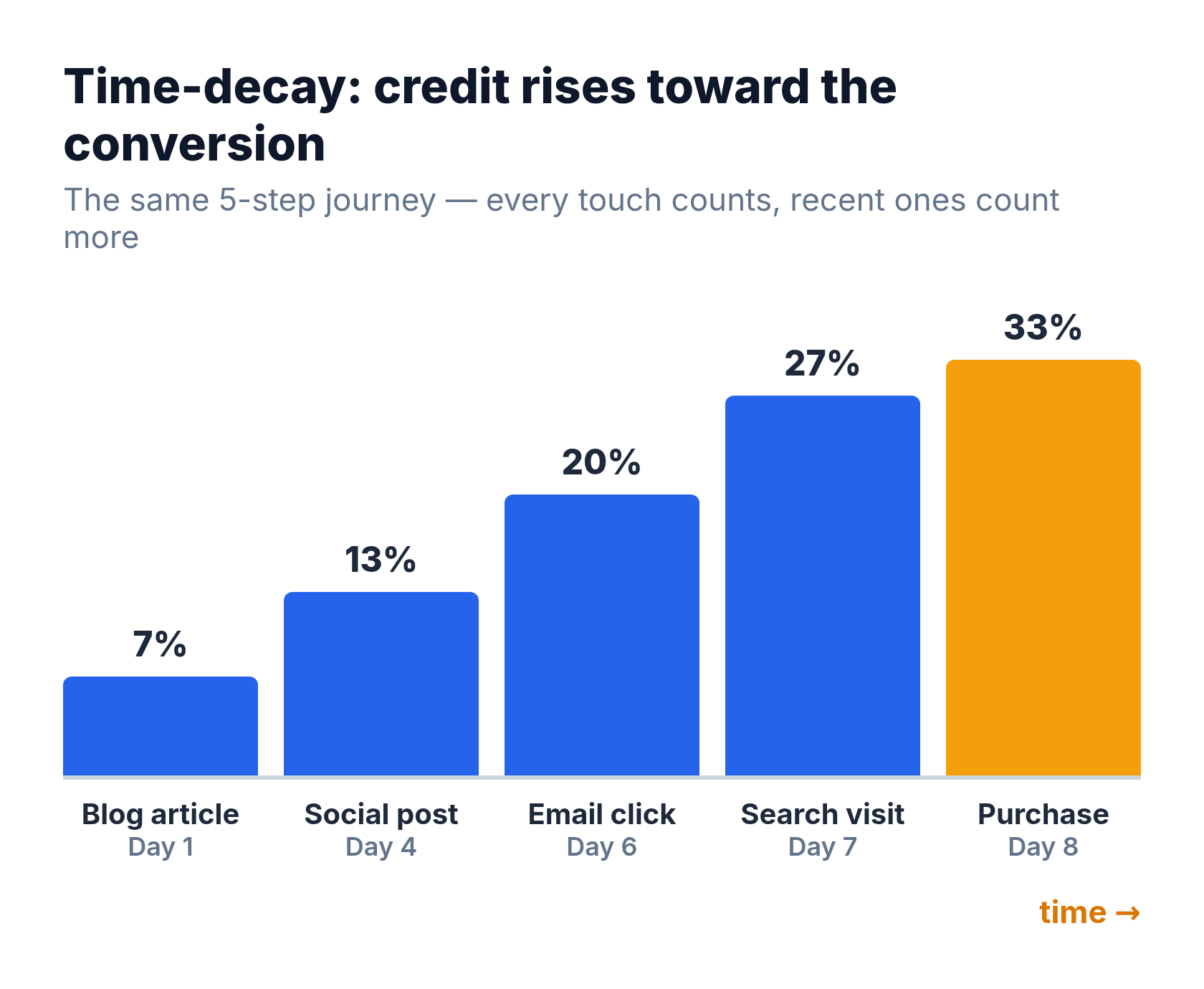
Here’s a simple example. Imagine someone takes five steps before buying:
| Touchpoint | When | Time-decay credit |
|---|---|---|
| Blog article | Day 1 | ~7% |
| Social post | Day 4 | ~13% |
| Email click | Day 6 | ~20% |
| Search visit | Day 7 | ~27% |
| Direct purchase | Day 8 | ~33% |
Notice that the blog article still earns credit for sparking the journey, but the email and search visits near the finish line get rewarded more heavily. As a result, you see the full path without pretending every step mattered equally.
When to Use Time-Decay Attribution
This model shines in specific situations. In my experience, it fits best when:
- Your sales cycle is short to medium. Time-decay assumes recent touches matter most, which holds up over days and weeks — not year-long enterprise deals.
- You run nurture campaigns. If email and retargeting do the closing, time-decay correctly credits that late-stage work.
- You want multi-touch without the complexity. It’s far more realistic than last-click, yet much easier to explain than data-driven models.
Conversely, if your customers research for months with many equal touchpoints, a linear or position-based model may reflect reality better. The right model always depends on how people actually buy from you.
Time-Decay vs Other Models
| Model | Credit distribution | Best for |
|---|---|---|
| Last-click | 100% to final touch | Quick, simple reporting |
| First-click | 100% to first touch | Top-of-funnel focus |
| Linear | Equal across all touches | Long, even journeys |
| Time-decay | Rising toward conversion | Nurture, short cycles |
The honest truth is that no model is “correct.” Each is a lens. Time-decay simply happens to match the most common buying pattern I see: a slow build that accelerates near the decision.
The Catch: Where Time-Decay Misleads
Every model has a blind spot, and time-decay has two worth knowing.
First, it systematically undervalues awareness. That blog post or first ad introduced you to the customer, yet it earns the least credit. Lean on time-decay alone and you may starve the very top-of-funnel work that fills the pipeline. My piece on multi-channel attribution digs into that trade-off.
Second, it depends on accurate tracking across touchpoints — which is harder than ever as cookies erode. If you can’t see the early steps, the model can’t credit them. Pairing it with reliable first-party data keeps the picture honest.
Frequently Asked Questions
Is time-decay better than last-click?
For most businesses, yes. Last-click ignores the entire journey and overcredits the final touch. Time-decay still favors recent touches but acknowledges the steps that led there, which usually reflects reality far better.
What’s the default half-life for time-decay?
A seven-day half-life is the common default, meaning a touch a week before conversion gets half the weight of one at conversion. You can shorten or lengthen it to match your actual sales cycle.
Does time-decay work for long sales cycles?
Less well. Over many months with lots of equal touches, time-decay over-rewards the end and buries early influence. A linear or position-based model usually fits long, complex journeys better.
Bottom Line
Time-decay attribution is the sensible middle ground between pretending only the last click matters and pretending every touch is equal. It credits the whole journey while rewarding the touchpoints that did the closing — which is exactly how most purchases actually unfold. Just remember its blind spot: it underrates the awareness work that started everything. Use it as your main lens for short, nurture-driven cycles, keep an eye on the top of the funnel, and back it with solid first-party tracking. In my experience, that combination gives you attribution you can actually act on.