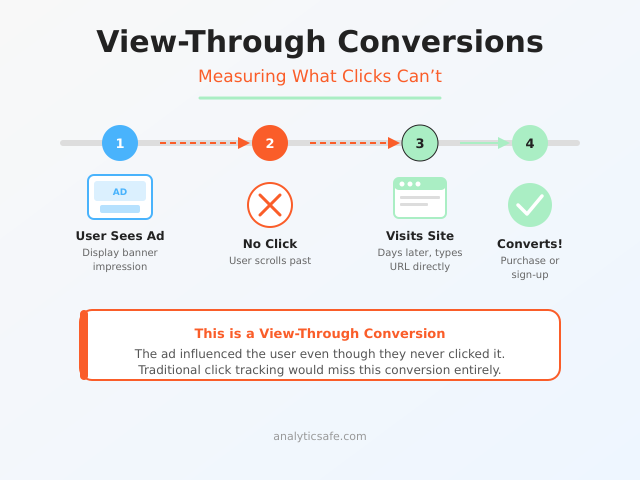
Most marketers obsess over clicks. However, view-through conversions tell the rest of the story. A visitor sees your display ad, doesn’t click, and then converts on your site three days later. That conversion still happened because of your ad. Consequently, if you only measure clicks, you’re missing a huge chunk of your advertising impact. In my experience, view-through conversions account for 20-40% of the true value of display and video campaigns.
This matters more than ever. Display advertising, video pre-rolls, and connected TV ads rarely generate direct clicks. Therefore, understanding view-through conversions is essential for any marketer who runs awareness campaigns. Let me walk you through what they are, how they work, and how to use them without inflating your numbers.
What Are View-Through Conversions?
A view-through conversion (VTC) happens when someone sees your ad, doesn’t click it, but later visits your site and completes a desired action. That action could be a purchase, a sign-up, or a download. The key difference from a click-through conversion is simple: no click on the ad occurred.
Think of it this way. You see a billboard for a new restaurant on your commute. You don’t stop immediately. Instead, you look it up that evening and make a reservation. The billboard influenced your decision. Similarly, view-through conversions capture the influence of digital impressions that don’t result in immediate clicks.
For example, the Interactive Advertising Bureau (IAB) has long recognized that impression-based metrics complement click-based measurement. In fact, the IAB recommends including view-through data in campaign reporting for display and video formats.
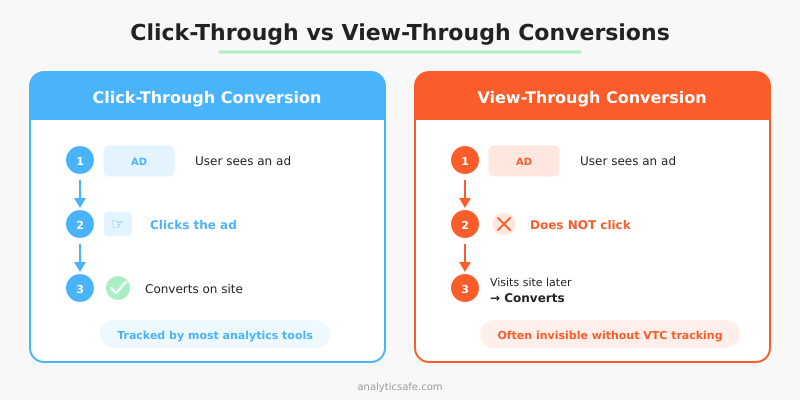
Here’s a quick comparison to clarify the difference:
| Metric | Click-Through Conversion | View-Through Conversion |
|---|---|---|
| User action on ad | Clicks the ad | Sees the ad (no click) |
| Path to conversion | Direct: ad click → site → conversion | Indirect: ad impression → later visit → conversion |
| Attribution strength | Strong and direct | Weaker, requires careful interpretation |
| Typical use case | Search ads, retargeting | Display ads, video, connected TV |
| Risk of overcounting | Low | Moderate to high without proper controls |
Understanding this distinction is critical. As I explain in my guide to attribution models for e-commerce and SaaS, different models weight these touchpoints differently. Consequently, your choice of model directly affects how view-through conversions appear in your reports.
How View-Through Tracking Works
The mechanics behind view-through conversions rely on a concept called an attribution window. When a user’s browser loads your ad, the ad server drops a cookie or records an identifier. If that user later converts on your site within the attribution window, the platform counts it as a view-through conversion.
Here’s the step-by-step process:
- Your ad loads in the user’s browser (an “impression”).
- The ad platform records the impression with a timestamp.
- The user does not click the ad.
- Within a set timeframe, the user visits your site independently.
- The user completes a conversion action.
- The platform matches the conversion to the earlier impression.
The attribution window length varies significantly across platforms. Moreover, you can usually customize it. Here’s a comparison of common defaults:
| Platform | Default VTC Window | Customizable Range | Notes |
|---|---|---|---|
| Meta Ads | 1 day | 1 day only (post iOS 14.5) | Reduced from 28 days due to Apple’s ATT |
| Microsoft Advertising | 7 days | 1-90 days | Flexible window settings |
| LinkedIn Ads | 7 days | 1-90 days | B2B campaigns benefit from longer windows |
| Amazon DSP | 14 days | 1-14 days | Useful for product awareness campaigns |
| The Trade Desk | Configurable | 1-30 days | Programmatic display and CTV |
| DV360 | 30 days | 1-30 days | Commonly used for display and video |
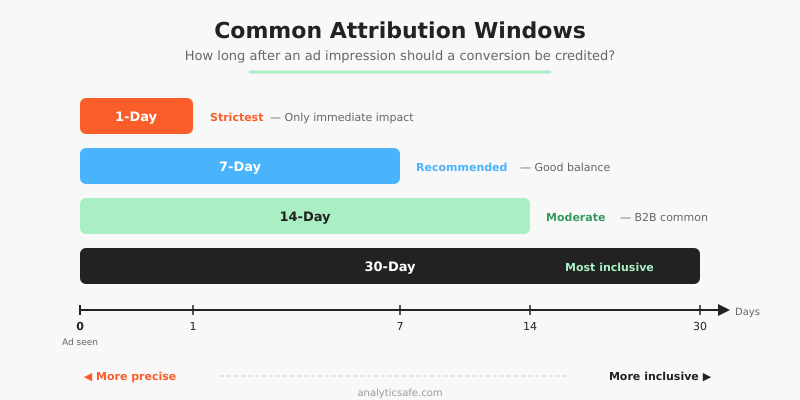
In my experience, shorter windows produce more reliable data. A 1-day window means the ad impression likely played a real role. A 30-day window, on the other hand, stretches credibility. Additionally, most platforms default to longer windows because it makes their ads look more effective.
When View-Through Conversions Matter
Not every campaign benefits from VTC tracking. However, several scenarios make it essential. Understanding when to rely on view-through data helps you allocate your measurement efforts wisely.
Display advertising is the classic case. Display ads have notoriously low click-through rates, typically 0.05-0.10% according to industry benchmarks from WordStream. Therefore, judging display campaigns by clicks alone massively undervalues them. VTC data reveals the impressions that actually drove brand awareness and later action.
Video campaigns follow a similar pattern. Most people don’t click on pre-roll video ads. Instead, they absorb the message and act on it later. Specifically, connected TV (CTV) advertising has no click option at all. VTC is the only way to measure CTV ad effectiveness. In fact, with CTV ad spend growing rapidly, VTC tracking becomes more important every year.
Retargeting also relies heavily on view-through data. When I work with clients running retargeting campaigns, I often find that VTC numbers dwarf click-through numbers. For instance, a user who sees a retargeting ad might simply type your URL directly rather than clicking the ad. That conversion still deserves attribution. Moreover, retargeting works precisely because repeated exposure builds familiarity over time.
Furthermore, brand awareness campaigns need view-through measurement by definition. These campaigns aim to plant a seed. Clicks are a bonus, not the goal. As I discuss in my piece on solving the last-click attribution problem, relying solely on clicks creates a massive blind spot in your marketing measurement.
Additionally, upper-funnel content promotion benefits from view-through tracking. If you promote blog posts or guides through display ads, users often read the content later without clicking the ad. Consequently, VTC data helps you understand whether your content distribution strategy is actually reaching people.
The Privacy Challenge
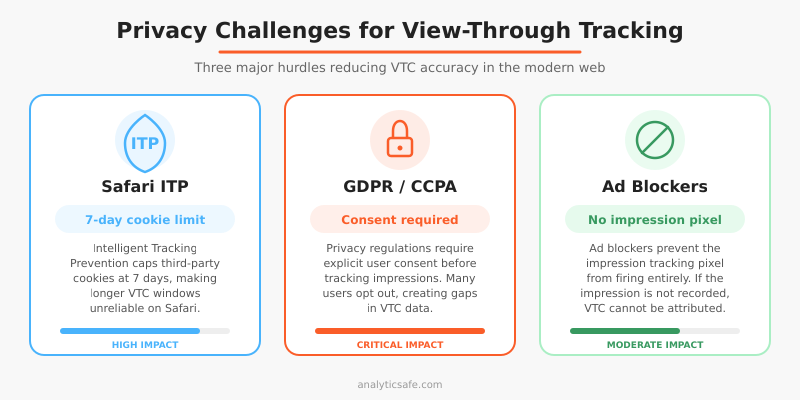
View-through conversion tracking faces serious headwinds from privacy regulations and browser changes. Consequently, the data is becoming less complete over time.
GDPR and consent requirements are the first hurdle. Under the EU General Data Protection Regulation, you need a lawful basis to track users across sites. View-through conversions inherently require cross-site tracking. Therefore, without proper consent, this tracking is not permitted in the EU. Most consent management platforms let users opt out, which reduces your trackable audience.
Browser-level restrictions add another layer. Apple’s Intelligent Tracking Prevention (ITP) in Safari limits third-party cookies aggressively. Firefox’s Enhanced Tracking Protection does the same. Moreover, Chrome is rolling out its Privacy Sandbox initiatives. These changes make cookie-based view-through tracking increasingly unreliable. As a result, many advertisers now explore server-side tracking and first-party data solutions to bridge the gap.
Apple’s App Tracking Transparency (ATT) reshaped mobile view-through tracking specifically. Since iOS 14.5, apps must ask permission before tracking users. Most users decline. As a result, Meta reduced its default view-through window from 28 days to just 1 day.
I’ve seen these privacy changes cut reported view-through conversions by 30-60% for some clients. However, this doesn’t mean the conversions stopped happening. It means we can no longer track them. That distinction matters enormously for budget decisions.
For a deeper look at how privacy regulations affect analytics overall, check out my guide to privacy-focused web analytics. It covers practical alternatives that respect user privacy while still providing useful data.
Common Mistakes with VTC Data
View-through conversion data is easy to misuse. In my experience, these five mistakes appear most often.
1. Treating VTC the same as click-through conversions. They are not equal. A click shows clear intent. An impression shows potential exposure. Therefore, lumping them together inflates your reported ROAS. Always separate them in your reporting.
2. Using excessively long attribution windows. A 30-day view-through window means that an ad someone saw a month ago gets credit for today’s purchase. That’s a stretch. In most cases, I recommend starting with a 1-day window and expanding only if your data supports it.
3. Double-counting across platforms. If a user sees your Meta ad and your LinkedIn ad before converting, both platforms claim the view-through conversion. Consequently, your total reported conversions exceed actual conversions. This is one of the biggest problems I see with multi-platform campaigns.
4. Ignoring organic and direct traffic overlap. A user might have found you through search anyway. The fact that they also saw your display ad doesn’t mean the ad caused the conversion. Nevertheless, the platform will claim credit. Always compare view-through conversion rates against a holdout group when possible.
5. Reporting VTC without context. Showing leadership a combined conversion number without explaining the VTC component erodes trust. Instead, always present view-through conversions as a separate line item with appropriate caveats.
A Practical Framework for Using VTC
After years of working with view-through data, I’ve developed a five-step framework that keeps the insights honest and actionable. Here’s what works in practice.
First, set conservative attribution windows. Start with 1 day for most display campaigns. For B2B with longer sales cycles, 7 days is reasonable. Only extend beyond that with strong evidence.
Second, apply a discount factor. Not all VTC numbers carry equal weight. Many analytics teams apply a 20-50% discount to VTC numbers. For example, if you recorded 100 VTCs, count them as 20-50 in your ROI calculations. This acknowledges the uncertainty inherent in impression-based attribution.
Third, run incrementality tests. The gold standard for measuring view-through impact is a controlled experiment. Serve real ads to one group and blank ads (or PSA ads) to a control group. Then compare conversion rates. The conversion lift study methodology provides a proven approach.
Fourth, segment your analysis. Break view-through conversions down by channel, creative, audience, and device. Specifically, look for patterns. Do certain ad formats generate more reliable VTC numbers? In my experience, video ads produce more trustworthy VTC data than static banners.
Fifth, maintain separate reporting columns. Always keep click-through and VTC numbers in separate columns. Moreover, show both raw numbers and your discounted figures. This transparency builds trust with stakeholders and prevents inflated expectations.
Here is a simplified reporting template I use with clients:
- Column 1: Click-through conversions (full value)
- Column 2: View-through conversions (raw count)
- Column 3: View-through conversions (discounted at 30-50%)
- Column 4: Total weighted conversions (Column 1 + Column 3)
- Column 5: Cost per weighted conversion
This approach gives you a realistic picture without completely ignoring the role impressions play.
Bottom Line
View-through conversions fill a critical gap in your measurement. Without them, you undervalue display, video, and awareness campaigns. However, without proper controls, they inflate your numbers and mislead your team.
The right approach sits in the middle. Track view-through conversions with short attribution windows. Discount them appropriately. Run incrementality tests when budgets allow. Most importantly, always report them separately from click-through conversions.
In my experience, the marketers who handle view-through conversions well gain a genuine competitive advantage. They make smarter budget decisions because they see the full picture. Meanwhile, teams that ignore VTC data entirely tend to cut display and video budgets prematurely. They never realize those channels were quietly driving results.
Ultimately, the goal isn’t to prove every ad works. It’s to understand which impressions actually move the needle. Start with conservative settings, build trust in your data, and expand from there. Your future self will thank you for the discipline.