Branded vs Non-Branded Traffic: What the Split Tells You

Branded vs non-branded traffic is one of those splits that quietly changes how you read every other number on your dashboard. When I audit a new client’s analytics, it’s the first segment I build. Why? Because a “great month” for organic traffic often turns out to be nothing more than people Googling the company name after a podcast mention. That’s lovely, but it isn’t SEO. The two types of search behave differently, and lumping them together hides the story you actually need.
So let me unpack what the split is, why it matters, and how to separate the two without leaning on invasive tracking.
What Is Branded vs Non-Branded Traffic?
The distinction is simple. Branded traffic comes from searches that include your name — “AnalyticSafe pricing,” “AnalyticSafe login,” or even a misspelling of it. Non-branded traffic comes from searches that don’t mention you at all, like “privacy-friendly analytics” or “how to read bounce rate.”
The difference matters because the two groups arrive in completely different mindsets. Branded searchers already know you; they’re often returning visitors or people who heard about you elsewhere. Non-branded searchers, by contrast, are discovering you for the first time through the content you’ve published.
Branded traffic measures how well-known you are. Non-branded traffic measures how discoverable you are. You need both numbers, but you need them separately.
Why the Split Matters
Here’s the trap I see constantly. A site’s organic traffic jumps 30% in a month, everyone celebrates, and nobody asks where it came from. When you split it, you find the company ran a webinar and got a press hit — so branded searches spiked, while the non-branded numbers stayed flat.
That’s an important distinction. Branded growth reflects marketing, PR, and word of mouth. Non-branded growth reflects your SEO and content. Therefore, if you want to know whether your articles are actually pulling in new people, you have to strip the brand searches out first.
What Each Type Tells You
- Rising branded traffic — your overall awareness is growing. Good, but it’s usually driven by activity off your site.
- Rising non-branded traffic — your content is reaching new audiences. This is the SEO needle you actually want to move.
- High branded, flat non-branded — you’re coasting on reputation while discovery stalls.
- Flat branded, rising non-branded — strong content momentum, even if the brand is still small.
In my experience, the healthiest small sites lean heavily non-branded early on, because nobody’s searching their name yet. As a brand matures, the branded share climbs. Neither pattern is “wrong” — but you can only see it once you separate them.
How to Separate Branded and Non-Branded Traffic
You don’t need a complicated setup or a third-party script for this. Google Search Console already has the data, and a single regular expression does the filtering.
The Search Console Method
Open the Performance report, add a Query filter, and switch the match type to “Custom (regex).” To see only branded queries, use a pattern like this:
- Branded only:
brandname|brand name|common misspelling - Non-branded only:
^(?!.*(brandname|brand name)).*
The second pattern uses a negative lookahead — it keeps every query that does not contain your brand terms. List your real misspellings too, because people are creative. Once you’ve got both views, you can compare clicks and impressions side by side. For the official rules, see Google’s Search Console performance documentation.
The Privacy-First Analytics Method
If you use a privacy-focused tool instead, you can often segment by referrer and landing page to approximate the same split. It’s less precise than query-level data, but it keeps you off the cookie-heavy path. I cover the broader setup in my guide to privacy-focused web analytics. Pair that with Search Console for the query detail, and you’ve got a clean, compliant picture.
What a Healthy Split Looks Like
People always ask me for the “right” ratio, and honestly, there isn’t one. It depends entirely on your stage and your market. That said, here are the rough patterns I trust:
| Stage | Typical branded share | What to focus on |
|---|---|---|
| New site / unknown brand | 5–15% | Non-branded content reach |
| Growing brand | 20–40% | Balance both, watch discovery |
| Established brand | 40–60%+ | Protect branded terms, expand topics |
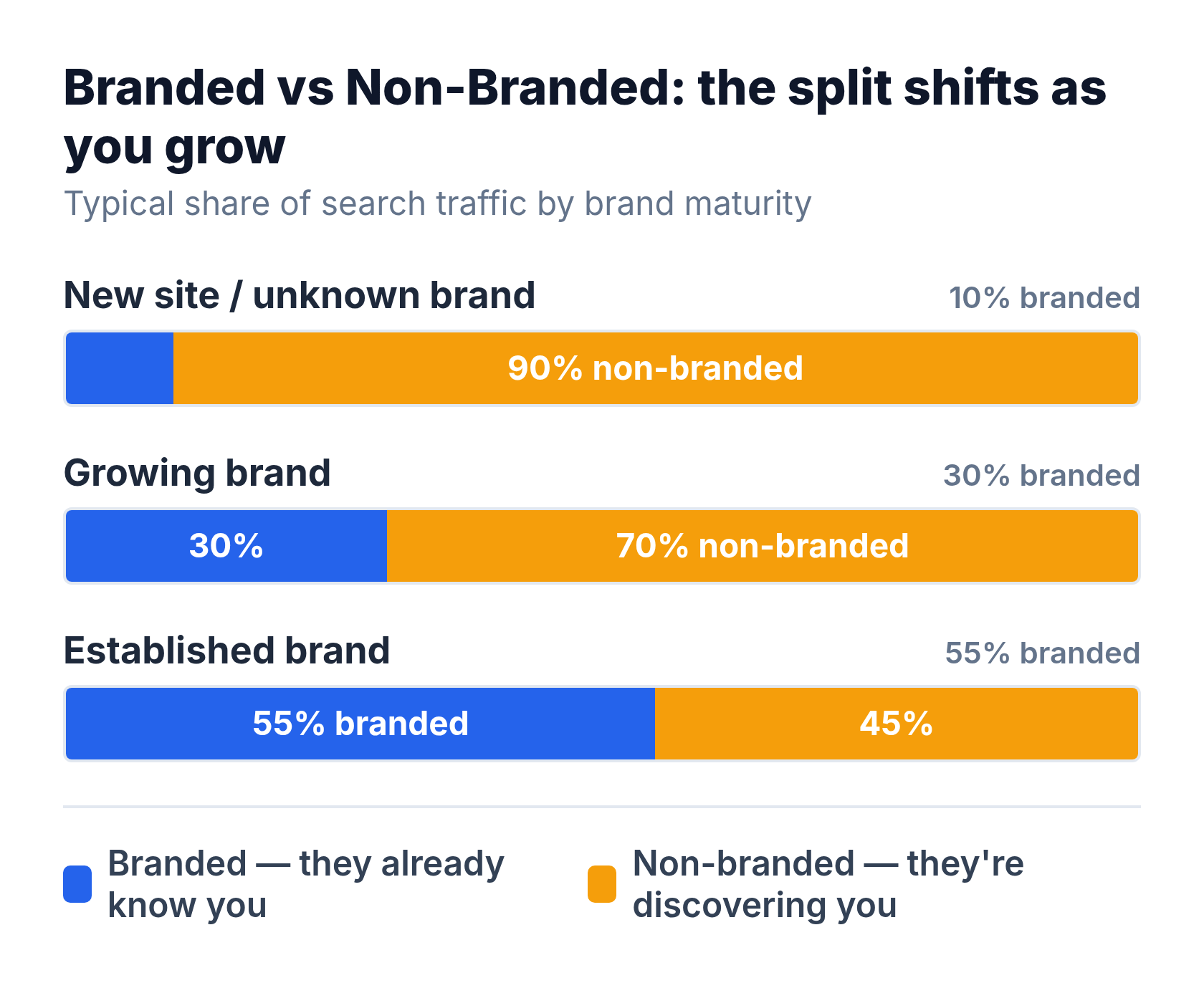
Notice that a high branded share isn’t automatically a win. A well-known brand with 70% branded traffic might have a discovery problem hiding under all that name recognition. Conversely, a tiny site that’s almost entirely non-branded is doing exactly what it should at that stage.
Common Mistakes When Reading the Split
A few errors come up again and again:
- Forgetting misspellings and variations. If your regex misses common typos, branded searches leak into your non-branded numbers and inflate them.
- Counting product names as non-branded. A trademarked product name is still branded. Decide where it belongs and stay consistent.
- Comparing across a rebrand or PR spike. A single viral moment distorts branded traffic for weeks. Annotate those events so future-you doesn’t misread the chart.
- Ignoring direct traffic. Brand-aware visitors often arrive without searching at all. My piece on direct traffic explains why that bucket overlaps with branded behavior.
Frequently Asked Questions
Is branded or non-branded traffic more valuable?
Neither is universally better. Non-branded traffic brings new audiences and proves your SEO works, while branded traffic signals loyalty and awareness. Strong businesses grow both, but you should track them separately to know which lever you’re pulling.
How do I handle a one-word brand that’s also a common term?
This is genuinely tricky. If your brand name is a dictionary word, lean on context — look at landing pages, related queries, and search intent rather than the keyword alone. Manual sampling helps you set sensible rules.
Can I track this without cookies?
Yes. Search Console works at the query level without any cookies, and most privacy-first analytics tools let you segment by referrer and page. Together they give you the split while respecting your visitors.
Bottom Line
Branded vs non-branded traffic isn’t a vanity split — it’s the difference between knowing your SEO works and just hoping it does. Branded searches measure how famous you are; non-branded searches measure how findable you are. Separate them with a simple Search Console regex, watch the two trends independently, and you’ll finally be able to tell real content growth apart from a lucky press week. In my experience, once you start reading traffic this way, you never go back to the blended number.