First-Party Data: Building Analytics That Don’t Rely on Cookies
First-party data is the quiet foundation that keeps your analytics working while everything around it shifts. For years, the headline was “the cookieless future is coming.” Then Google blinked, kept third-party cookies in Chrome, and a lot of people decided the whole issue was overblown. It wasn’t. The ground really is moving under tracking — just not in the dramatic, all-at-once way the headlines promised.
So let me clear up what actually changed, why first-party data matters more than ever, and how to build analytics that don’t depend on cookies you can’t control.
What Is First-Party Data?
First-party data is information you collect directly from your own audience, on your own site, with a direct relationship to the person. Think page views on your domain, on-site search, email signups, and purchases. By contrast, third-party data is gathered by someone else — usually via cookies set on domains you don’t own — and sold or shared for tracking across the wider web.
The distinction matters because you control first-party data and you don’t control the third-party kind. When a browser or a regulation changes the rules, your first-party data keeps working. The borrowed stuff does not.
First-party data is the relationship you own. Third-party data is the relationship you rent — and the landlord keeps changing the lease.
What Actually Happened to Cookies?
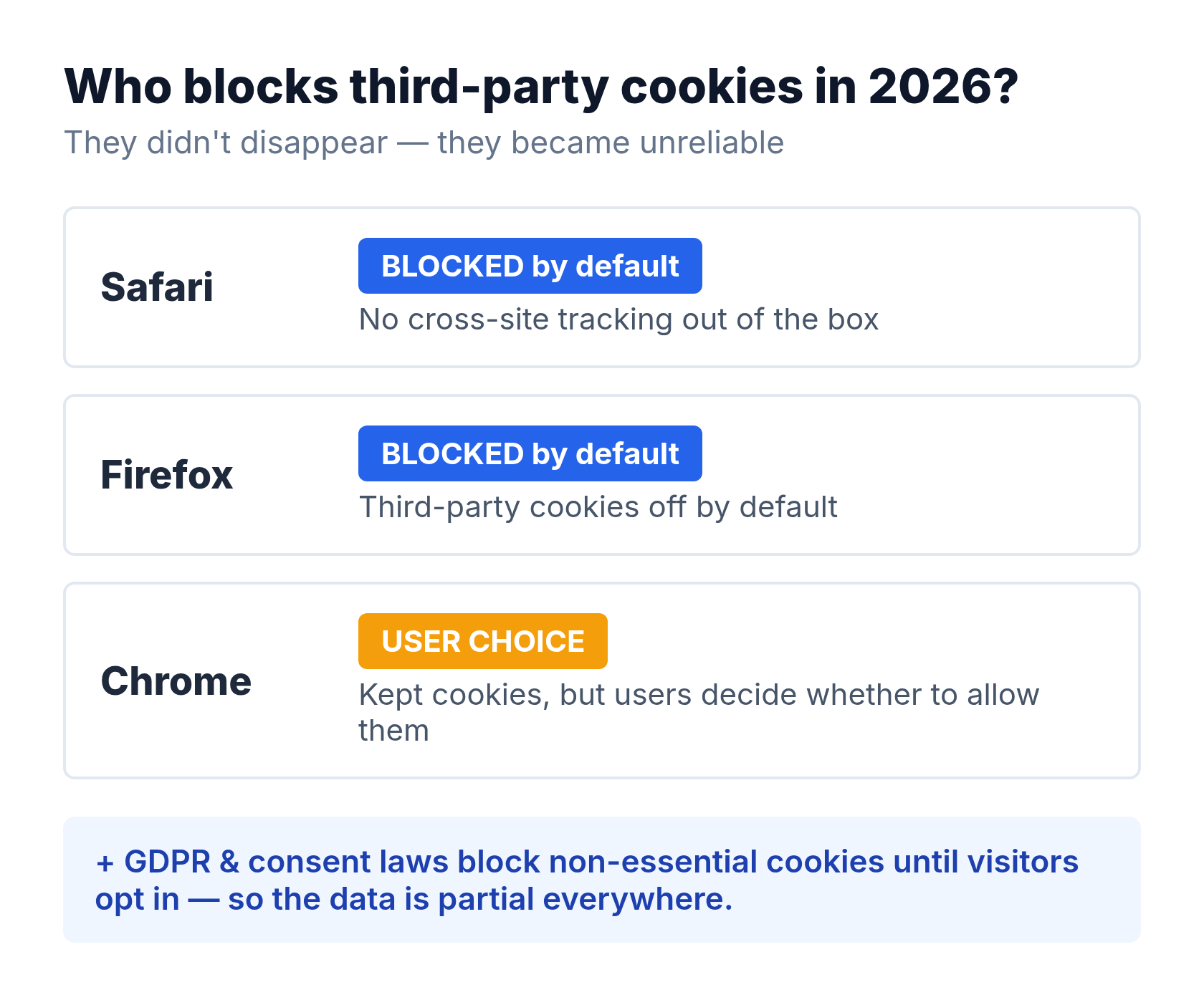
Here’s the part everyone gets wrong. Third-party cookies didn’t disappear, but they did get a lot less reliable. The picture in 2026 looks like this:
- Safari and Firefox already block third-party cookies by default. That’s a large slice of your audience invisible to cross-site tracking right now.
- Chrome reversed its plan to remove them entirely. Instead, it leans on user choice, letting people decide whether to allow third-party cookies at all.
- GDPR and similar laws require consent before non-essential cookies fire, so a chunk of European visitors never get tracked regardless of the browser.
Add those together and the message is clear. Third-party cookies still exist, but you can no longer build your measurement on them. The data they return is partial, inconsistent, and shrinking. For a sense of how much that consent gap alone costs, see my piece on cookie consent impact.
Why First-Party Data Wins
When the borrowed data gets shaky, the data you own becomes the stable core of everything. There are three reasons it holds up.
It Survives Browser Changes
First-party measurement runs on your own domain, so the cross-site blocking in Safari and Firefox simply doesn’t apply the same way. Whatever Chrome decides next, your direct relationship with your visitors stays intact. In my experience, that durability is worth more than any clever tracking trick.
It’s More Accurate
Because first-party data comes straight from your own site, it skips the leakage and guesswork of stitching together third-party signals. You’re measuring what people actually did on your pages, not an inferred profile assembled elsewhere. Therefore, the numbers you act on are closer to reality.
It Builds Trust
Collecting data directly, with clear purpose, is far easier to explain to your visitors than a web of third-party trackers. That honesty isn’t just good ethics — it’s good business. People increasingly choose services that respect their privacy, a theme I cover in my guide to privacy-focused web analytics.
First-Party vs Third-Party Data
| Aspect | First-party data | Third-party data |
|---|---|---|
| Source | Your own site and audience | Collected elsewhere, shared/sold |
| Control | You own it | You rent it |
| Reliability in 2026 | Stable | Eroding (browser + consent limits) |
| Accuracy | High — direct observation | Lower — inferred profiles |
| Privacy risk | Lower, easier to explain | Higher, harder to justify |
How to Build First-Party Analytics
You don’t need an expensive data platform to do this well. A few deliberate choices cover most of it.
- Use a first-party, cookieless analytics tool. Privacy-focused options measure visits from your own domain without setting cross-site cookies, so they keep working as browsers tighten up.
- Invest in direct relationships. Email lists, accounts, and on-site preferences are first-party gold. They belong to you and don’t vanish when a browser updates.
- Capture intent on your own pages. On-site search terms, filters used, and content viewed tell you what people want — no third party required.
- Be transparent about collection. Say plainly what you gather and why. Clear consent earns you more usable data than a sneaky tracker ever will.
When I move a client off third-party dependence, the first month feels strange because the numbers shift. Then it clicks: the data is smaller but truer, and it stops breaking every time a browser ships an update.
Common Mistakes
- Assuming cookies are “fine now.” Chrome’s reversal doesn’t undo Safari, Firefox, or consent law. The erosion is real even if the deadline moved.
- Confusing first-party cookies with third-party ones. A first-party cookie set by your own domain is far less affected than a cross-site tracker.
- Waiting for a forced deadline. The shift is gradual, so there’s no alarm bell. Sites that prepare early simply keep measuring while others scramble.
Frequently Asked Questions
Are third-party cookies gone in 2026?
No. Chrome still allows them under user choice, but Safari and Firefox block them by default, and consent laws limit them further. They exist, yet they’re too unreliable to base your analytics on.
Is first-party data GDPR-compliant?
It can be, and it’s usually easier to justify. You still need a lawful basis and clear notice, but collecting data directly with transparent purpose is far simpler to explain than third-party tracking.
Do I need cookies at all for first-party analytics?
Not necessarily. Many privacy-first tools measure first-party visits without any cookies, which sidesteps both consent banners and browser restrictions while still giving you the metrics that matter.
Bottom Line
First-party data is the part of your measurement that nobody else can switch off. Third-party cookies didn’t vanish overnight, but between Safari, Firefox, and consent law, they’ve quietly become a foundation you can’t trust. The fix isn’t a panic — it’s a pivot. Build on the data you own: direct visits, real signups, on-site behavior, collected transparently. In my experience, sites that make that move stop worrying about the next browser headline entirely, because their analytics no longer depend on it.